

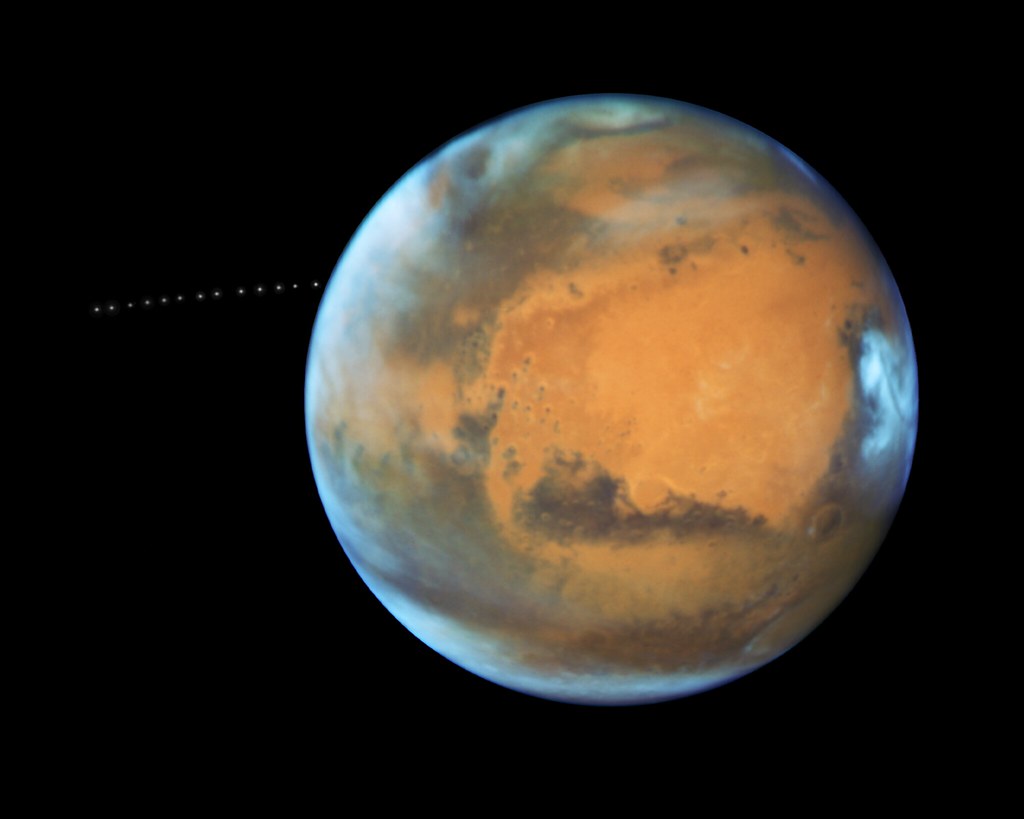
The Mars moon Phobos mission is a historic endeavor by Japan to retrieve samples from the Martian moon, Phobos. This mission aims to deepen our understanding of the solar system.
Overview of the Mars moon Phobos mission
Japan has embarked on a groundbreaking journey with its Mars moon Phobos mission, aiming to collect samples from the Martian moon Phobos and return them to Earth. This ambitious project, spearheaded by the Japan Aerospace Exploration Agency (JAXA), marks Japan’s first attempt to retrieve extraterrestrial materials from beyond the Moon.
The mission is set to launch a spacecraft named MMX (Martian Moon eXploration), which is designed to perform several key tasks:
- Orbit around Mars: The spacecraft will enter a stable orbit around the Red Planet to conduct various scientific observations.
- Land on Phobos: It will attempt to land on Phobos, where it will collect surface samples that may provide insights into the moon’s origin and its relationship with Mars.
- Return to Earth: After gathering samples, MMX will return to Earth, bringing back precious materials for further analysis.
This mission is not only significant for Japan but also represents a step forward in our understanding of Mars and its moons, highlighting the potential for future interplanetary exploration.
Significance of bringing back samples
The significance of bringing back samples from Mars moon Phobos cannot be overstated. This mission aims to provide invaluable insights into the formation and evolution of both Phobos and Mars, thereby enhancing our understanding of the solar system.
Scientists believe that the surface materials of Phobos contain unique information about its history, including:
- Material Composition: Analyzing the samples will reveal the minerals and elements present, which can inform us about the moon’s origin.
- Impact History: The samples may show evidence of past impacts from asteroids or comets, shedding light on the dynamic environment of the early solar system.
- Planetary Processes: Studying the geological features of Phobos can provide clues about the processes that shaped Mars and its moons.
Moreover, the mission contributes to future space exploration endeavors. By mastering the techniques needed to collect and return samples from Phobos, Japan paves the way for more ambitious missions, including potential human exploration of Mars itself. The Mars moon Phobos mission is not just about collecting rocks; it’s about expanding our horizons in space science.
Technology used in the mission
The Mars moon Phobos mission utilizes cutting-edge technology to achieve its ambitious goals. One of the key components of the mission is the spacecraft, which is engineered to withstand the harsh conditions of space and the unique environment of Phobos.
Equipped with advanced propulsion systems, the spacecraft will employ ion thrusters for greater efficiency during its journey. This technology allows for precise maneuvering, essential for navigating the complex gravitational fields of Mars and its moons.
Additionally, the mission incorporates sophisticated scientific instruments designed to analyze the surface composition of Phobos. These instruments include:
- High-resolution cameras for capturing detailed images of the moon’s surface.
- Sample collection tools to gather rock and dust samples from Phobos.
- Spectrometers for determining mineral composition.
The data gathered will not only enhance our understanding of Phobos but also inform future explorations of Mars. By employing this innovative technology, the Mars moon Phobos mission represents a significant step forward in space exploration.
Timeline for the Phobos mission
The timeline for the Mars moon Phobos mission is ambitious yet achievable, with critical milestones set to guide Japan’s exploration efforts. This mission is planned to unfold over a period of approximately ten years, starting with the launch of the spacecraft.
- 2024: The spacecraft is expected to launch from Earth, utilizing advanced propulsion technology to reach Mars.
- 2025: After a year of travel, the spacecraft will enter Martian orbit and begin its detailed study of Phobos.
- 2026: The spacecraft will land on the surface of Phobos, where it will collect samples of the moon’s regolith and other materials.
- 2027: Sample collection is set to be completed, followed by the spacecraft’s departure from Phobos.
- 2028: The spacecraft will begin its journey back to Earth, carrying valuable samples that could unlock secrets about the moon’s history.
- 2030: The mission culminates with the return of the spacecraft to Earth, where scientists will analyze the samples.
This timeline highlights Japan’s dedication to advancing space exploration through the Mars moon Phobos mission.
Future implications for space exploration
The Mars moon Phobos mission represents a significant leap forward in our understanding of planetary science and astrobiology. As Japan embarks on this bold new space adventure, the implications for future exploration are profound.
Firstly, the successful collection and return of samples from Phobos could provide insights into the building blocks of our solar system. Scientists believe that analyzing these samples may reveal information about the early conditions of Mars and the presence of organic materials, which could inform the search for extraterrestrial life.
Additionally, the technologies developed for the Mars moon Phobos mission may pave the way for future missions to more distant celestial bodies. Innovations in propulsion and sample collection can enhance mission efficiency and safety, encouraging more countries to participate in space exploration.
Moreover, the mission could strengthen international collaboration in space research. By sharing findings and resources, countries can work together to tackle the challenges of exploring not just Mars, but other planets and moons in our solar system.
In conclusion, the Mars moon Phobos mission is not just about exploring a single satellite; it is about laying the groundwork for humanity’s future in space.
By NASA Goddard Photo and Video via Openverse
References
You might also like
- Is Motorola iPhone Duo the Best New Smartphone?
- Oppo F11 Pro: The Best Smartphone with Proven Features
- Oppo Find X10 Series: The Best Launch Details You Need